


The Dry Martini is a quintessential cocktail that has captivated drinkers for generations. At its core, what makes a Dry Martini dry is the minimal use of dry vermouth relative to the primary spirit, be it gin or vodka. This emphasis on the spirit’s flavour is the defining characteristic of the Dry Martini.
Key Takeaways:
- Dryness in a Martini refers to the reduced sweetness and increased dryness from less vermouth used.
- Common Dry Martini ratios range from 4:1 to an extreme 15:1 (spirit to vermouth).
- Proper preparation involves stirring, not shaking, the Martini to achieve optimal chill and dilution.
- Ordering a Dry Martini precisely, such as “5:1 ratio, twist,” ensures consistency.
- Varying degrees of dryness, from “Extra Dry” to “Bone Dry,” offer tailored experiences.
Defining the Dry Martini
A Dry Martini is defined by its minimal use of dry vermouth in relation to the primary spirit, be it gin or vodka. This emphasis on the spirit’s flavour is the hallmark of the Dry Martini, as the reduced sweetness and increased dryness from less vermouth create a more assertive, spirit-forward profile.
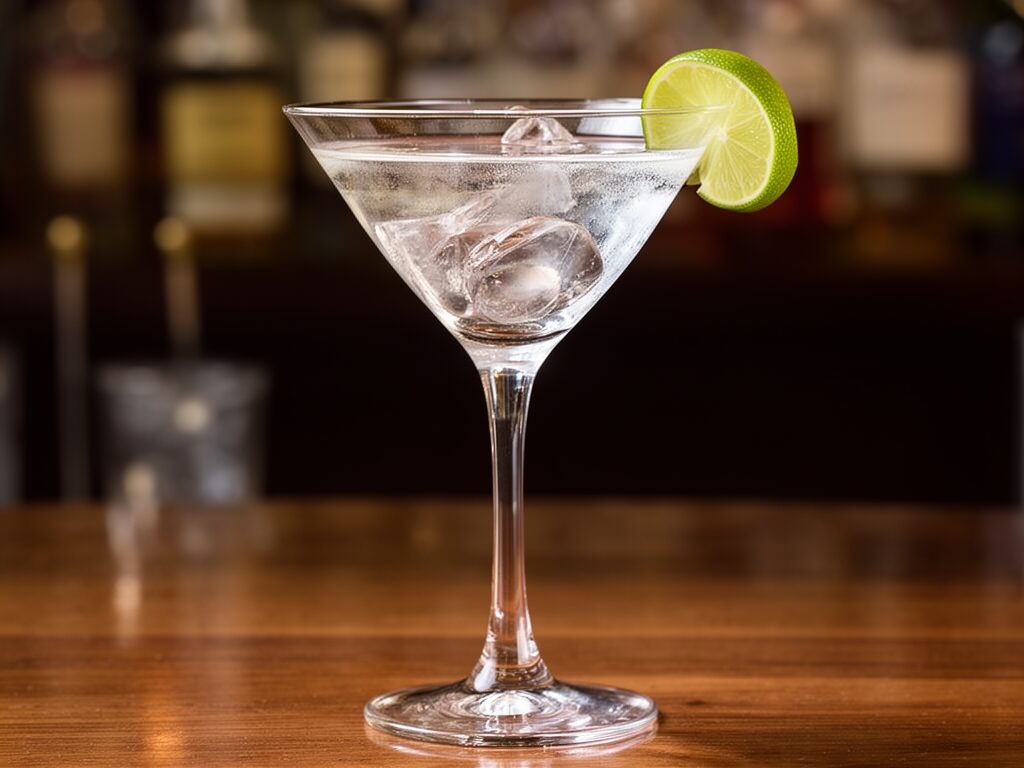
The less vermouth used, the drier the Martini. Ratios can range from a standard 4:1 or 5:1 (spirit to vermouth) to the extreme “Montgomery” at 15:1, where just a glass rinse or atomiser spritz of vermouth is used to impart a subtle hint of the fortified wine.
Classic Ingredients and Ratios
The core ingredients of a Dry Martini are 60ml (2oz) gin or vodka and 1 barspoon (≈5-15ml or 1/6-½oz) of dry vermouth. Dry vermouth, at 15% ABV and 45 calories per serving, provides a delicate, herbaceous accent to the 40% ABV, 148-calorie gin or vodka.
Some of the most common Dry Martini ratios include the 4:1 (60ml gin, 15ml vermouth), the “Dickens” 5:1 (62.5ml gin, 12.5ml vermouth), and the typical modern 6:1 dry. At the extreme end, the “Montgomery” is a 15:1 ratio (75ml gin, 5ml vermouth).
Preparation Method
To craft the perfect Dry Martini, the drink is stirred (not shaken) in a mixing glass with cubed ice for 15-45 seconds until thoroughly chilled. This gentle agitation helps to reduce dilution compared to shaking, which can introduce unwanted air bubbles. The chilled Martini is then julep strained into a pre-chilled coupe or Martini glass, and garnished with a lemon twist or a pair of olives. A dash of orange bitters is an optional, yet classic, addition.
Degrees of Dryness and Ordering Tips
The spectrum of Dry Martini dryness ranges from the “Extra Dry,” where just a few drops or glass rinse of vermouth is used, to the “Bone Dry,” where the vermouth is spritzed via atomiser after the spirit has been poured.
When ordering, use precise ratios to ensure consistency: “Dry Martini, 5:1 ratio, twist” is a clear way to communicate your preferences to the bartender.
Conclusion
The Dry Martini is a timeless and sophisticated cocktail that celebrates the spirit’s flavour through the minimal use of dry vermouth. From the classic 4:1 or 5:1 ratios to the extreme “Bone Dry” versions, the Dry Martini offers a range of experiences to delight the palate. Whether enjoyed for its elegant simplicity or as a statement of one’s refined taste, the Dry Martini remains an enduring and iconic libation.
Sources:
Dry Martini: History, Recipe and Secrets of the Most Elegant Cocktail
Dry Martini Recipe
Dry Vs Dirty Martini – A Bar Above
The Classic Dry Martini
Martini (cocktail) – Wikipedia
Martini Cocktail – Martini ratios
Essential Terminology: How to order the perfect Martini | Sipsmith Gin
How to make a Dry Martini #cocktail #bartender #martini
The Dry Martini, the most enduring classic cocktail – Blossom to Stem
The Martini – Defined, Explained and How to make – Difford’s Guide
A Martini Quandry (dry vs. extra dry) – Spirits and Cocktails
